
The ankle-brachial index is a quick, painless test comparing ankle and arm blood pressure to screen for peripheral artery disease and reduced leg circulation. Through our network of accredited hospitals and vascular specialists in India, we help international patients access accurate testing and clear, expert interpretation.
Ankle-Brachial Index Testing in India
The ankle-brachial index, or ABI, is a simple, painless test that compares the blood pressure at your ankle with the pressure in your arm. The ratio between the two is a quick, reliable indicator of how well blood is flowing to your legs, and a useful screen for peripheral artery disease, a narrowing of the arteries that supply the limbs.
What the test reveals
When leg arteries narrow, the blood pressure at the ankle drops relative to the arm. By measuring both and comparing them, the ABI gives a clear number that signals whether circulation to the legs is healthy or reduced, often before symptoms become obvious.
Why it is done
Doctors use the ABI to investigate symptoms such as leg pain on walking that eases with rest, slow-healing wounds on the feet, or cold, pale lower limbs. It is also used to screen people at higher risk, including smokers and those with diabetes, high blood pressure or high cholesterol.
How it is performed
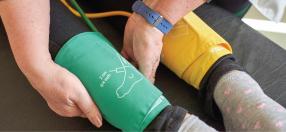
You lie down while a technician measures blood pressure at both arms and both ankles using a cuff and a small handheld ultrasound device. The test is entirely painless, involves no needles, and usually takes only around fifteen minutes.
Reading the result
The result is expressed as a ratio. A normal value suggests healthy flow, while a lower value points to narrowing in the leg arteries, with the degree of reduction hinting at how significant the disease is. Your doctor interprets the number alongside your symptoms and risk factors.
What follows
If the ABI suggests peripheral artery disease, it opens the door to early action, from lifestyle changes and medication to, where needed, procedures to restore flow. Catching reduced circulation early helps protect your mobility and lowers the risk of more serious complications.
How we help
A small test can flag a problem worth treating early. We connect you with accredited hospitals and vascular specialists in India who can perform ABI testing, interpret your results clearly, and arrange any further investigation or treatment, so circulation problems are caught and managed in good time.
We are a medical facilitation service, not a healthcare provider. All medical care is delivered by the accredited hospitals and qualified specialists in our network. Treatment suitability and outcomes are determined by your treating doctors.
Get a Free Quote
Speak with our care team about this treatment and receive a personalised estimate.
Request a Quote