
A Diagnosis Is the Start of a Plan, Not the End of Hope
If you or someone you love has just been diagnosed with breast cancer, the fear and flood of unfamiliar terms can feel overwhelming. We want you to know something important: breast cancer care has advanced enormously. Many women today achieve excellent cancer outcomes while keeping their body image, breast sensation, and quality of life largely intact. Understanding your options is the first step toward feeling in control again — and that’s exactly what this guide is for.
As a medical facilitation service, we don’t treat patients ourselves. Our role is to help you understand what’s possible and to connect you with the accredited hospitals and specialists in India who deliver this care. The clinical insights below draw on the expertise of leading breast surgeons such as Dr Deepti Singh, Consultant in Breast Surgery & Surgical Oncology at Fortis Cancer Institute, Mohali, whose work in modern and robotic breast surgery informs much of what we share here.
There Is No Single Treatment — and That’s a Good Thing
One of the most reassuring facts about modern breast cancer care is that treatment is tailored to you: your cancer type, its stage and biology, your genetics, age, health, and personal wishes. At leading centres, no single doctor decides your path alone. Instead, a multidisciplinary tumour board — surgical, medical, and radiation oncologists, plus radiologists and pathologists — reviews your full picture together. This team approach is one of the markers of a truly world-class cancer programme, and it’s something we prioritise when connecting you to a hospital.
Surgery: The Foundation
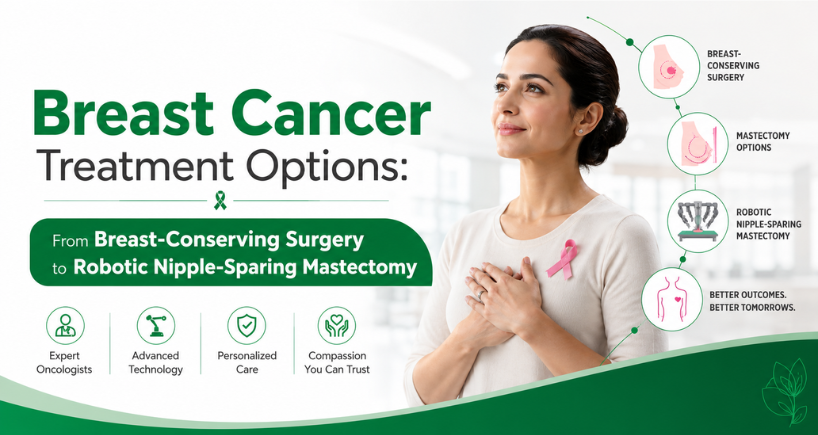
Breast-Conserving Surgery (Lumpectomy)
This removes the tumour along with a small margin of healthy tissue, preserving most of the breast, and is usually followed by radiation. For many early-stage cancers, this approach offers survival outcomes comparable to removing the whole breast — making it the preferred option whenever it’s safe.
Mastectomy Now Far Gentler Than Before
When more tissue needs to be removed — because of tumour size, multiple tumours, a BRCA gene mutation, or patient preference — mastectomy may be recommended. But modern mastectomy has moved a long way from the disfiguring procedures of the past.
Nipple-Sparing Mastectomy
In suitable patients, the breast tissue is removed while the skin and nipple are preserved, allowing immediate reconstruction with far better cosmetic and emotional results. This depends on the tumour being a safe distance from the nipple.
Robotic Nipple-Sparing Mastectomy The Latest Advance
The newest evolution uses a robotic surgical platform, with the surgeon operating through a single small incision hidden in the armpit. The breast tissue is removed through that concealed cut, preserving the skin and nipple for immediate reconstruction. Reported advantages include no visible scar on the breast, highly magnified 3D precision around delicate structures, lower risk of complications, better preserved sensation, and cancer-safety outcomes comparable to traditional surgery. For the right patient, it addresses the three things women worry about most identity, sensation, and scarring without compromising on removing the cancer.
Who Is Suitable for Robotic Surgery?
It isn’t right for everyone. It’s generally considered for early-stage cancers with a small-to-moderate breast size, a tumour located safely away from the nipple, non-smokers, and those without prior chest radiation. It’s also an excellent option for BRCA carriers choosing risk-reducing surgery before any cancer develops. It’s not appropriate for inflammatory breast cancer, tumours involving the nipple or skin, or larger, more ptotic breasts where results would be less predictable. Only a specialist evaluation can determine your candidacy.
Rebuilding Afterward: Breast Reconstruction
Reconstruction can be done immediately, during the same operation — which pairs especially well with nipple-sparing techniques for a natural result from day one — or delayed by weeks or months when further treatment like radiation is planned.
Beyond Surgery
Surgery is often just one part of the plan. Chemotherapy may come before surgery to shrink a tumour or after it to clear residual cells. Hormone therapy treats the most common, hormone-driven cancers over several years to cut recurrence. Targeted therapies attack specific molecular drivers — such as HER2-positive disease or BRCA-mutated cancers — with remarkable precision. Immunotherapy has transformed outcomes for aggressive triple-negative cancers. And radiation therapy, now delivered in shorter modern courses, reduces the chance of the cancer returning.
You Don’t Have to Navigate This Alone
A diagnosis abroad, far from home, can feel isolating — but it doesn’t have to. We connect you with accredited cancer hospitals and experienced breast surgeons in India, help you understand your options and likely costs upfront, and coordinate everything from second opinions and multidisciplinary evaluations to travel and aftercare. You focus on your recovery; we handle the connections.
Clinical source & credit: The medical information in this article is informed by the expertise of Dr Deepti Singh, Consultant in Breast Surgery & Surgical Oncology, Fortis Cancer Institute, Mohali, who specialises in breast-conserving surgery, nipple-sparing and robotic breast surgery, oncoplastic techniques, and sentinel lymph node biopsy. For a personalised evaluation, patients can be connected to Dr Singh and the multidisciplinary breast cancer team at Fortis Mohali through our service.
We are a medical facilitation service, not a healthcare provider. This article is for general education only and is not medical advice. All diagnosis and treatment decisions are made by your treating doctors.
Hi, this is a comment.
To get started with moderating, editing, and deleting comments, please visit the Comments screen in the dashboard.
Commenter avatars come from Gravatar.